
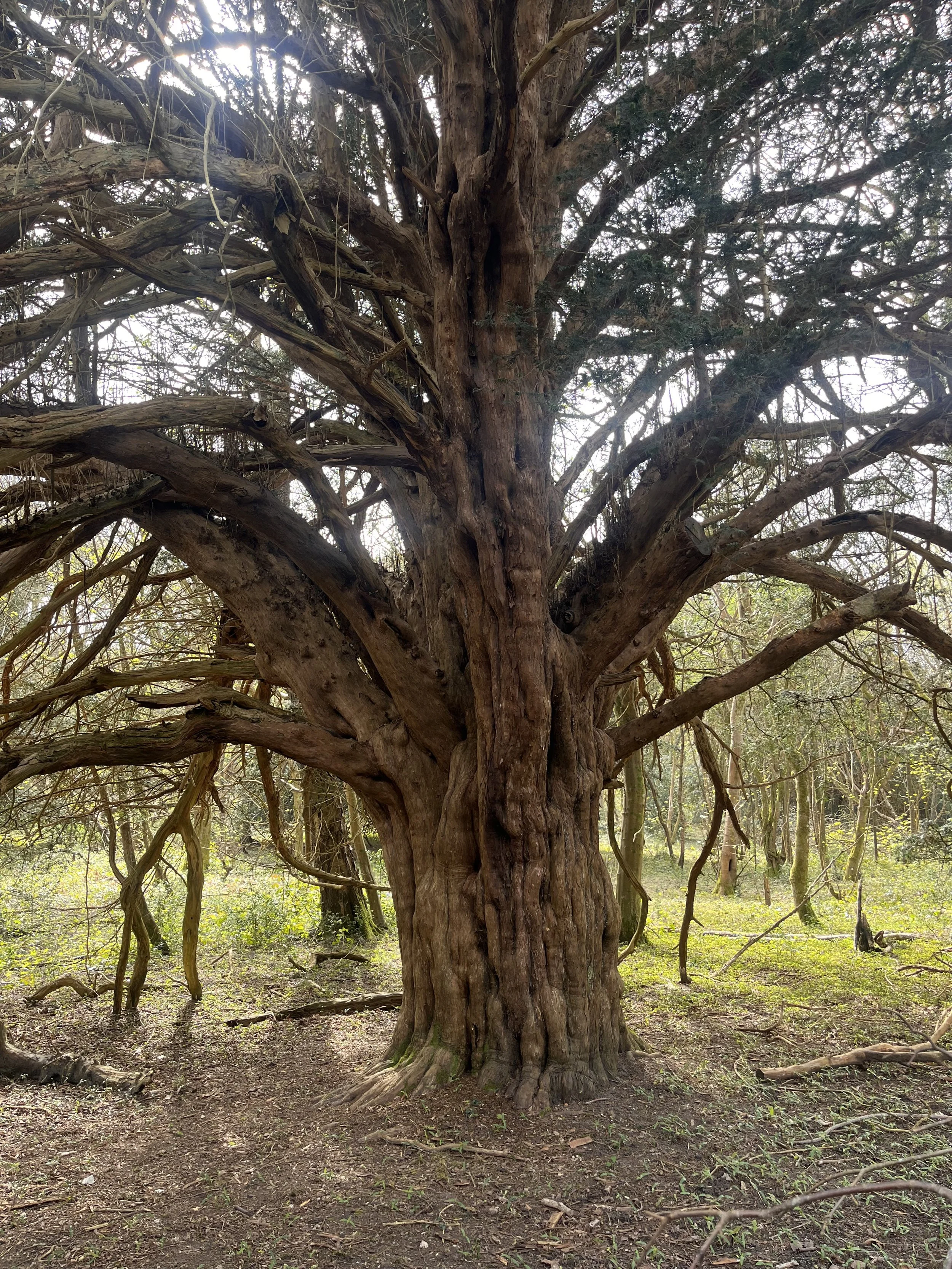
There yew trees in the Surrey Hills that are over 1,000 years old!
I’m trying to wrap my head around that time frame and put it into some sort of perspective.
These trees were already growing at the time of the Norman Conquest in 1066, and they have continued to live through centuries of dramatic change, including the Medieval period, Tudor England, the Industrial Revolution, and both World Wars. While empires have risen and fallen around them, these trees have quietly endured.
Symbols of longevity and memory
It’s not surprising then, that yew trees are often linked with longevity, endurance, and even immortality. Across the UK, you’ll often find them in churchyards, where they’ve long been tied to remembrance and the passing of time.
A tree that can renew itself
One of the most remarkable features of the yew is its ability to regenerate. Branches can bend down to the ground, take root, and form new growth while still remaining connected to the mother tree.
From ancient trees to modern medicine
Despite their ancient associations, yew trees are also important in modern science. Compounds derived from the trees have been used in the development of anti-cancer treatments.
Living bridges between past and present
I find it mind blowing that these trees are living links between the world we know today and a past stretching back over a millennium!
Come and explore this ancient woodland and living piece of history with me on one of my guided Surrey Hills hikes.